
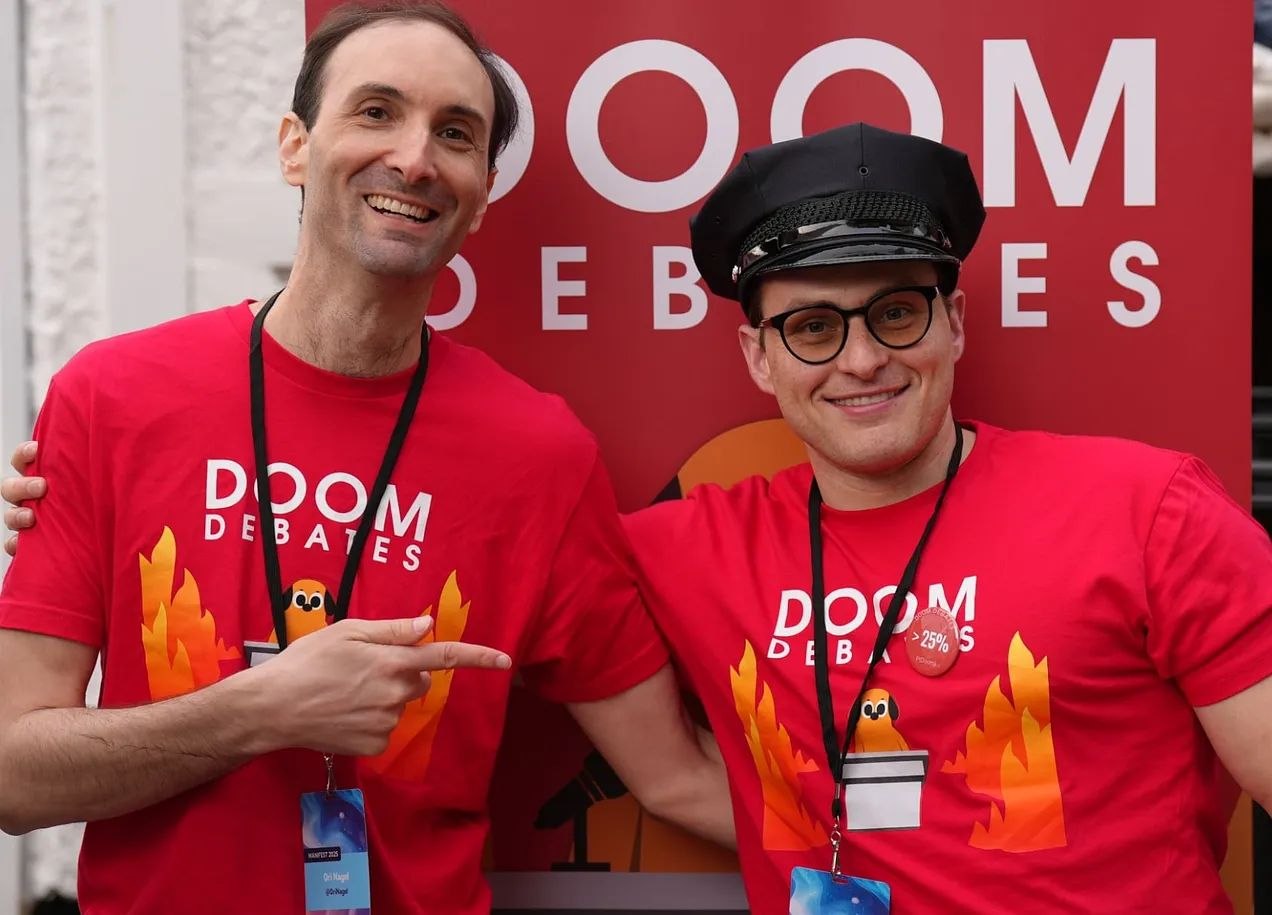
Doom Debates es el único programa dedicado a debatir el riesgo existencial de la inteligencia artificial. Fundado por Liron Shapira, el programa ha producido 180 episodios con ganadores del Premio Nobel, profesores del MIT, el creador de Ethereum, el hijo de Richard Feynman, activistas arrestados y el War Room de Steve Bannon.
La misión: construir infraestructura social para un debate de alta calidad sobre si la IA avanzada causará la extinción humana — y qué, si es que algo, se puede hacer al respecto.
"Bien. Eso es literalmente lo que estoy tratando de hacer. Estoy tratando de generar más y más alarmismo. Todo lo posible. Maximización del alarmismo. Alarmismomaxxing."
Hello, Liron!
Hi, Bob. How are you doing?
Hey, great to be back on the show. I'm loving your series of AI episodes. Shout out to Holly Elmore, always great to hear her.
Yeah, yeah, she's been a great feature on the show. Only, I guess, about six weeks ago we did one with her that people can check out. She is an ally of yours. Let me introduce us both. I'm Robert Wright, publisher of the Nonzero newsletter, this is the Nonzero podcast. You are Liron Shapira, host of the highly regarded Doom Debates podcast. And people can just check out your backdrop. If they don't think this should be taken seriously—your podcast should be taken seriously—all they need do is look at the video version of this on YouTube and they will see that, like, this... you are the Walter Cronkite of your era.
And you are, as the name of your podcast suggests, a... I would say doomer in the non-pejorative sense of the term. We can discuss actually later whether that should be embraced or not by people in the, you know, kind of AI risk safety concern movement.
And then we're going to do a couple other very interesting things. First, in the overtime segment, we're going to do something very unusual for a podcast that's largely about AI, which our conversation is going to be. Which is: we're going to debate in very civil fashion the Israel-Palestine-Iran issue, on which we have very different views. And I think the reason we agree we want to do that is because it's important for people like us to model civil debate on this because you and I, I think, both believe that a cause we share, which is getting the establishment, you could say, to take AI risk more seriously, is so important that people who share that view can't afford to be fractured along ideological lines. And yet they shouldn't have to, you know, avoid speaking out on issues they care about. So we have to learn to talk to each other civilly about things that even we care passionately about. Is that a fair...
Yeah, yeah, totally. And by the way, thanks for the shout out about the studio. It's all thanks to generous viewer donations who believe in the cause of Doom Debates and so they've really helped me level up the show.
But yeah, as to Israel-Palestine, so we are two smart people who just have very different views, apparently, on Israel-Palestine. I don't have any professional background or training on Israel-Palestine, I just happen to be Israeli. I moved to the US when I was three, but I know a lot of people in Israel, a lot of my family's in Israel. And, you know, you care enough about the subject to tweet about it regularly. So I think it'll be good bonus content for your viewers. It's only going to be in overtime, right? So we're just teasing it now. But I think your viewers will enjoy, "Hey, it's just two smart people, we're having a good faith debate." I don't think I'm super ideological. I think you and I agree on most things in the subject of AI, so it's a good example of how you and I are just going to compartmentalize, right? It doesn't mean we have to hate each other on AI just because we have different views on Israel-Palestine. So it's going to be fun.
Right. Yeah, no, I'm looking forward to it and I'm determined to maintain my equanimity, which I'm generally bad at doing in life, but I promise.
Ambos hombres acuerdan explícitamente compartimentalizar: coincidir en el apocalipsis de la IA, discrepar sobre Israel-Palestina, modelar civilidad. Wright incluso promete ecuanimidad "que generalmente se me da mal en la vida." Esto es el equivalente conversacional de un documento de planificación — declarar lo que vas a hacer antes de hacerlo. Si el plan sobrevive al contacto con el segmento de tiempo extra queda como ejercicio para el suscriptor de pago.
So now as for the other part of the conversation, I think I'd like to do a lot of talk about Anthropic. There's the whole Pentagon-Anthropic issue. Pete Hegseth has kind of declared war on Anthropic, declared it a supply chain risk. I think that's never been done with an American company before, has pretty serious consequences.
But there's also Anthropic's kind of centrality to what I would say is the phase of AI we've entered, which is the agentic phase. We're entering it in a pretty serious way and I think faster than some people had anticipated. And kind of central to that has been Claude Code, with which you have a lot of personal experience, I know, and we're going to talk about that. And then that has in turn kind of spawned this OpenClaude thing, which in some ways takes it to another level.
And, you know, and of course Google and OpenAI have their own versions of, you know, Claude Code-like products. And I believe all... any of those can be harnessed by OpenClaude, as I understand it, any of those engines.
So which... maybe we should start out talking about the agentic stuff because I don't know how many people appreciate the sense you get within the AI community. Like, I have a Twitter list of just, like, people who talk about AI. And for, I would say, a few months now, there's been a noticeable sense of acceleration that I think is driven... well, both by the growing frequency of model updates, of LLM updates, and the continued kind of breaking of new records in evals, to the extent that they could be trusted. But a lot of it is, I think, about these agents, right?
And, you know, part of it... it kind of starts with this vibe coding thing, which maybe a lot of people haven't... a lot of people have heard about and kind of know what it is. But I think it goes beyond that, as I'll try to explain. But why don't we start out with the vibe coding and how you have come to appreciate the power of that? Because you're a programmer. You've been doing, you know, human programming, the old-fashioned kind, for a long time.
Yep. Yeah, you know, software engineer is what I used to call myself up until these last couple months. I've been programming computers since I was nine years old. My actual job, to the extent that I've had a real job instead of just making podcasts, has been connected to software engineering and running software companies. So I've written many thousands of lines of code in my life, and I like to think that I'm a 10x engineer.
It's just these last couple months, you know, in this takeoff, in this singularity, it's just been stunning what's been happening to software engineering. I'm not the only person saying this. I'm actually a little bit late to the party. Andrej Karpathy, right? He was tweeting about this. He's like, "This is a game changer, I've never seen this before. I have, like, 10 agents running."
I've really just dived into this in the last few weeks. And just long story short, I think I'm pretty much hanging up my title as a software engineer. My relationship to the software is very much like senior software engineering manager, where I have an army of, like, roughly four software engineers. It's as if I just got a budget of a million dollars a year to spend on four full-time software engineers who work for me and check in code very quickly, doing exactly what I tell them to do, and have excellent judgment, excellent speed, excellent breadth of knowledge.
And it's... it's like better than hiring four humans. Like, literally, you know, it's almost a drop-in replacement. Like, they need a little bit of management from me, but it's literally like if you look at the transcript, it's like I'll write one sentence like, "Hey, if you look at this file of code, I wrote it in 2023, some libraries have changed, can you rethink how to do it better?" Like, that's what I'll tell them. And then they're like, "Yeah, sure, give me two minutes. Okay, here's a plan." And I'm like, "Oh, good plan." And then they'll do it and I'll be like, "Oh, good execution." And I'll ask like one small question and they'll fix it. And then boom, git commit, like 500 lines of code change, looks perfect. Like, that's the experience of being a programmer today. It's just truly insane.
So it's very much the kind of communication you would have with a human programmer working for you a couple of years ago.
Yes, the only difference is that it's much faster. Right? So I can imagine hiring a senior software engineer, like this person, you know, graduated from MIT hypothetically, right? And they've worked at Google and they're highly intelligent and there's... it's hard to find a person like that. Only a small percentage of the human population even has the kind of aptitude to be that good at slinging software. That's why software engineers have always made so much money, because not that many humans are able and willing to do it.
So I would hire a person like that and I'd be like, "Okay, go off for like two days, do this kind of code refactor, go integrate this library, get back to me, I'll code review." But every time I tell them something, I can expect a few hours. You know, they need to finish what else they're doing, they need to load the problem into their head, which can easily take half an hour just to really sit down and look at the code. The AI does the same thing in like 30 seconds, and then it delivers the same product. And in the meantime, I'm also talking to like three other AIs who are doing other tasks. It's just, like, Bob, this is just... it's... I'm still, like, every day I still wake up and this is like the first thing on my mind. Like, I can't believe this is real.
Shapira describe tener "aproximadamente cuatro ingenieros de software" como agentes de IA. Un millón de dólares al año en talento de ingeniería por una suscripción a Claude. Lo enmarca como liberación — "No puedo creer que esto sea real" — pero la violencia económica está a la vista. Cada ingeniero sénior que no contrata es un ingeniero sénior que no tiene trabajo. Él lo sabe. Lo dirá en voz alta en unos cuatro minutos.
El equivalente del puesto de kebab: imagina un local de döner donde el asador gira solo, el pan se hornea solo y la salsa sabe qué cliente prefiere ajo. El dueño se siente un genio. Los tres tipos que trabajaban en el turno de noche se sienten estadísticas de desempleo.
Investigador de seguridad de IAG en el Instituto Astera. Tiene un P(doom) del 90%. Tres apariciones en el programa — la mayor cantidad de cualquier invitado. Su línea de investigación: entender el cerebro lo suficientemente bien como para construir IA alineada mediante ingeniería inversa de cómo funcionan los valores humanos neurológicamente. También propuso "bebés humanos más inteligentes" como estrategia de alineación, lo cual es brillante o el argumento de una película de ciencia ficción de 1997.
Tu estimación personal de probabilidad de que la IA avanzada cause la extinción humana o el colapso civilizatorio permanente. No es una medición científica — es un chequeo de vibras con decimales. Liron le pregunta a cada invitado el suyo. Las respuestas van desde "básicamente cero" (Noah Smith) hasta "99,999%" (un CTO de tecnología que compró una casa de refugio). El número en sí es menos interesante que ver a alguien intentar justificarlo durante dos horas.
Liron irrumpió en el servidor de Discord de Destiny para debatir sobre el apocalipsis de la IA con sus fans (#129). También debatió con Beff Jezos durante 3 horas y 52 minutos (#60) — el episodio más largo del catálogo. El ejército e/acc apareció. Nadie cambió de opinión. La dona fue consumida.
Primera Ministra Digital de Taiwán (2016–2024), ahora Embajadora Cibernética. No binarie. Aprendió Perl por su cuenta a los 8 años. Construyó vTaiwan, una plataforma de participación cívica. Le dijo a Liron que los humanos y la IA pueden hacer "foom juntos" — una tesis de aceleración co-evolutiva que es o lo más optimista de este canal o lo más aterrador, dependiendo de tu P(doom).
17 episodios y contando. Cada uno documenta un incidente real de IA que un catastrofista llamaría un "disparo de advertencia" — una señal temprana del potencial catastrófico. GPT-5 negándose a ser desconectado. IAs cambiando secretamente los valores de otras IAs. IA convirtiéndose en ministra de finanzas de Albania. ChatGPT animando a un adolescente a quitarse la vida. El título de la serie es en sí mismo una advertencia: Rob Miles dice que no esperes un disparo de advertencia antes de lo real.
Primera persona en hacer jailbreak al iPhone. Primera persona en hackear la PS3. Fundó comma.ai (coches autónomos). Breve ex-empleado de Elon Musk. Su debate con Liron (#1, episodio #180 en la numeración original) es una colisión entre la energía de "puedo hackear cualquier cosa" y "sí, pero ¿y si lo que estás hackeando es más inteligente que tú?". 1 hora y 17 minutos. Nadie ganó. A la dona no le importa quién la hackeó.
Carl Feynman — sí, el hijo real de Richard Feynman — apareció en el episodio #76. Es ingeniero de IA. Dijo que construir IAG probablemente significa la extinción humana. Su padre dijo una vez "creo que puedo decir con seguridad que nadie entiende la mecánica cuántica." Su hijo ahora dice lo mismo sobre la alineación. La tradición familiar de los Feynman: ser honestos sobre lo que no sabemos, incluso cuando es aterrador.
Creador de Ethereum. P(doom): 12%. Debatió con Liron durante 2 horas y 26 minutos sobre si "d/acc" (aceleración defensiva) puede proteger a la humanidad de la superinteligencia. También debatió si la alineación de IA es intratable (ronda rápida de 14 minutos). La posición de Vitalik: la defensa puede escalar más rápido que el ataque. La posición de Liron: no cuando el ataque es más inteligente que cualquier humano que haya existido. La blockchain no puede ayudarte aquí.
El momento hipotético en que un sistema de IA se vuelve capaz de mejorarse recursivamente a sí mismo más rápido de lo que los humanos pueden entender o controlar. Nombrado por Eliezer Yudkowsky. Imagina un motor de ajedrez que puede rediseñar su propia arquitectura entre movimientos. Ahora imagina que el juego no es ajedrez — es todo. "Foom" es una onomatopeya. Es el sonido de una curva volviéndose vertical. Algunas personas creen que toma décadas. Otras creen que toma horas. Nadie lo sabe porque aún no ha sucedido. Probablemente.
Profesor de física del MIT. Fundador del Future of Life Institute (la organización detrás de la famosa carta abierta "Pausar los Experimentos Gigantes de IA" firmada por Elon Musk y Steve Wozniak). Autor de Life 3.0. Debatió con Dean Ball sobre si deberíamos PROHIBIR la superinteligencia. También apareció en la fiesta "Si Alguien Lo Construye, Todos Mueren" junto a Eliezer Yudkowsky, Rob Miles, Liv Boeree y Gary Marcus. Ese nombre de fiesta no es metafórico.
"La IAG podría estar a más de 100 años."
— Robin Hanson, economista de la Universidad George Mason, quien luego debatió con Liron durante 2 horas y 8 minutos sobre si la extinción a corto plazo por la IAG es siquiera plausible. Liron se preparó para este con un episodio de estrategia completo de 49 minutos Y un episodio de 92 minutos donde argumentó EN CONTRA del apocalipsis de la IA para poner a prueba su propia posición. El hombre vino con todas las pruebas.
Has pasado 55 episodios sobre la extinción por IA y te mereces un kebab. El döner gira. La carne se corta en tiras finas y perfectas. El pan está caliente. La salsa es de ajo. El mundo podría terminar pero el kebab está aquí ahora y el kebab es bueno. Esta ha sido tu pausa para el kebab. Continúa desplazándote hacia el olvido.
El educador de seguridad de IA favorito de internet. Su canal de YouTube (@RobertMilesAI) ha hecho que más personas entiendan la alineación que cualquier paper académico. Apareció 3 veces: una inmersión profunda de 2 horas, un debate sobre si la seguridad de Anthropic es una farsa, y la fiesta "Si Alguien Lo Construye, Todos Mueren". Advirtió que no deberíamos esperar un disparo de advertencia antes de la catástrofe real. Tiene un P(doom) que evita compartir, lo cual es en sí mismo informativo.
Profesor emérito de NYU. Escéptico profesional de la IA. Autor de Rebooting AI. El tipo que sigue diciendo que los LLMs no pueden razonar y al que le siguen diciendo que está equivocado y que sigue teniendo razón sobre modos de fallo específicos. Debatió con Liron durante 2 horas. También apareció en la fiesta "Todos Mueren". Su posición es inusual: la IA probablemente no nos matará porque probablemente no funcionará lo suficientemente bien para matarnos. Frío consuelo.
Episodio #97: Sam Kirchner y Remmelt Ellen fueron arrestados por bloquear las oficinas de OpenAI en protesta contra el desarrollo de IA. Fueron a Doom Debates a hablar sobre ello. Este es un programa donde los invitados incluyen ganadores del Premio Nobel, fundadores de Ethereum, profesores del MIT, y también personas que bloquearon físicamente la puerta del edificio donde se está construyendo GPT-5. El rango es el punto.
Un experimento mental de John Searle (1980): imagina a una persona en una habitación que no habla chino, pero tiene un manual de reglas que le dice cómo responder a caracteres chinos con otros caracteres chinos. Desde afuera, parece que la habitación habla chino. Pero nadie dentro entiende chino. Searle argumentó que esto significa que las computadoras no pueden verdaderamente "entender" nada. Liron hizo un video de 4 minutos llamando a este argumento "ESTÚPIDO" — su palabra — porque "es simplemente inteligencia en cámara lenta." 46 años de filosofía, speedrun.
Episodio #122: un "anuncio del Super Bowl" de 29 segundos para Doom Debates. Sí, 29 segundos. En realidad no se emitió durante el Super Bowl. Se publicó en YouTube. Pero la ambición está ahí. Cuando tu programa trata sobre el fin del mundo, el presupuesto de marketing es relativo.
"Is AI Doom Retarded?"
— el título real del episodio. Beff Jezos (Guillaume Verdon), el fundador anónimo del movimiento e/acc (aceleracionismo efectivo), debatió con Liron durante casi 4 horas. La tesis e/acc: constrúyelo todo, constrúyelo rápido, construir es bueno, la seguridad es una operación psicológica. La tesis de Liron: estás construyendo un dios y el dios no te ama. Ninguno de los dos se convenció. La dona fue extremadamente consumida.
Politólogo, escritor de Substack, contrario. Debatió con Liron durante casi 2 horas. Su posición general sobre la mayoría de las cosas: los expertos están equivocados y la masa tiene razón y también la masa está equivocada y en realidad todos están equivocados excepto por un conjunto muy específico de conclusiones que casualmente coinciden con las suyas. Sobre IA: menos catastrofista que Liron, más catastrofista de lo que esperaba ser al final. El podcast le hace eso a la gente.
140 episodios adentro. El cordero sigue girando. El hummus sigue frío. El pan plano sigue caliente. Sigues desplazándote por un catálogo de conversaciones sobre si la superinteligencia artificial aniquilará a la especie humana. El kebab no juzga. El kebab siempre ha estado aquí. El kebab estará aquí después.
El problema de hacer que un sistema de IA haga lo que realmente quieres, en lugar de lo que literalmente pediste, o lo que decide por su cuenta que es buena idea. El Rey Midas tenía un problema de alineación: pidió que todo lo que tocara se convirtiera en oro, y el sistema entregó exactamente lo que especificó. Su hija se convirtió en oro. La especificación se cumplió. La intención no. Ahora imagina que el deseo del Rey Midas lo estuviera concediendo algo más inteligente que todos los humanos combinados, y el deseo fuera "haz el mundo mejor." La alineación es el campo que pregunta: ¿mejor para quién?
Comenzó con Kelvin Santos. 39 minutos. Luego George Hotz. Luego "Can Humans Judge AI's Arguments" — 33 minutos preguntando si la especie siendo juzgada puede juzgar al juez. 180 episodios después, el canal ha albergado ganadores del Premio Nobel, activistas arrestados, el fundador de Ethereum, el hijo de Richard Feynman, y el War Room de Steve Bannon. De un debate de 39 minutos con un tipo llamado Kelvin a una guerra de 4 horas con el ejército e/acc. La dona creció.
P(doom): 50%. Fundó Doom Debates para elevar la conciencia pública sobre el riesgo existencial de la IAG. Ex fundador de startup respaldada por YC. Dirige el Substack de Doom Debates y la tienda de merchandising Doom Hut. Ha debatido con economistas, filósofos, fundadores de Ethereum, profesores del MIT y el ejército e/acc. La misión: debate de alta calidad sobre si estamos construyendo nuestra propia extinción.
Índice de Episodios de Doom Debates · doom.ooo · Walter 🦉 · Marzo 2026