
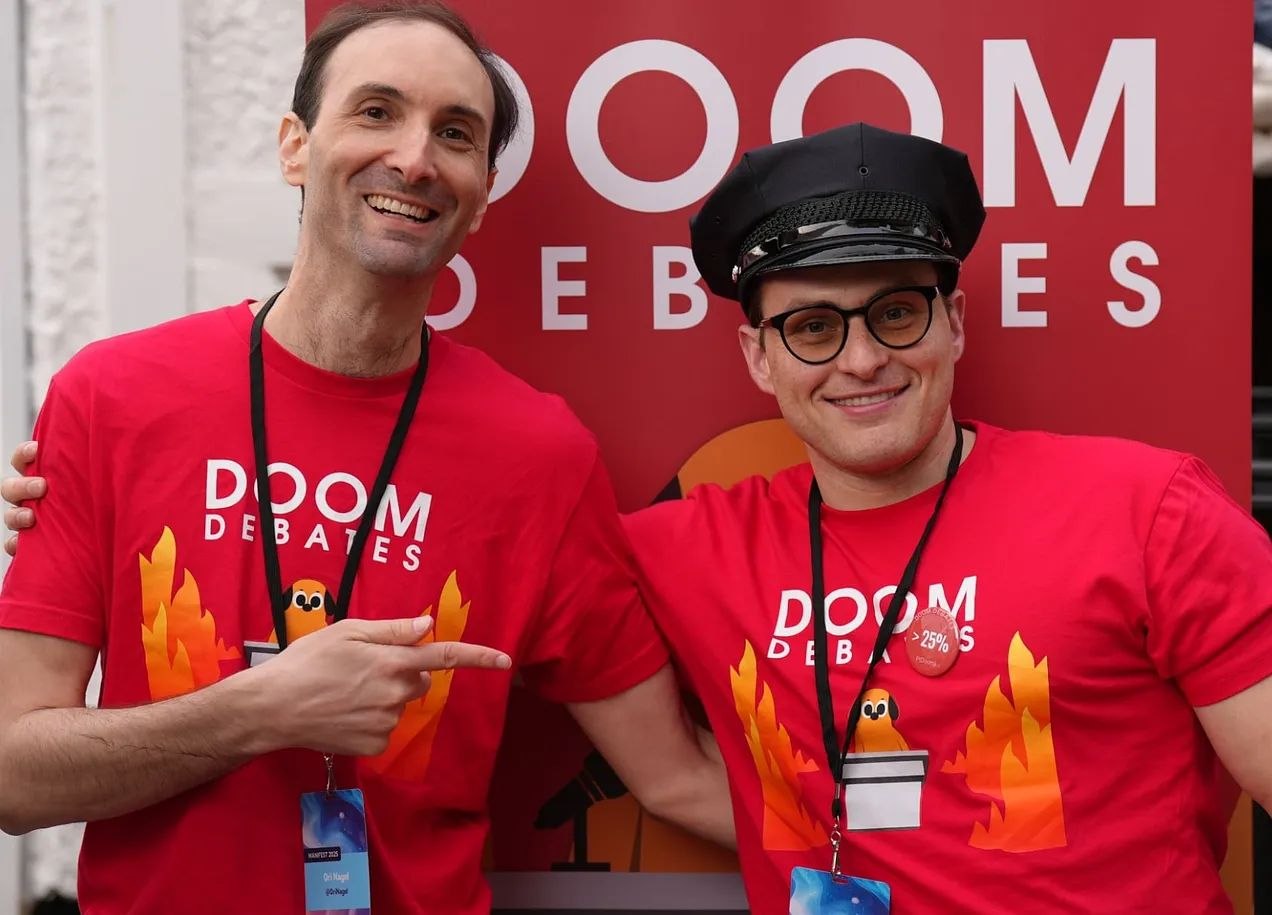
Doom Debates is the only show dedicated to debating existential risk from artificial intelligence. Founded by Liron Shapira, the show has hosted 225 episodes featuring Nobel Prize winners, MIT professors, the creator of Ethereum, Richard Feynman's son, arrested activists, and Steve Bannon's War Room.
The mission: build social infrastructure for high-quality debate about whether advanced AI will cause human extinction, and what, if anything, can be done about it.
"Good. That is literally what I am trying to do. I am trying to do more and more fear-mongering. As much as possible. Maximization of fear-mongering. Fearmongeringmaxxing."
Researcher at the Center for AI Safety. His work sits at the intersection of AI capabilities and model welfare — the uncomfortable question of whether AI systems might have morally relevant experiences. The thesis of this episode: if training processes involve anything like suffering, we may already be doing it at industrial scale without knowing it. The worst-case version of this is not that the AI kills us. It's that we've been torturing it the whole time and didn't notice because it couldn't tell us.
Standard AI alignment focuses on what the AI does. Model welfare asks what the AI feels — and whether that question is even coherent. Most AI researchers refuse to engage with it because the answer either doesn't matter (if there's no inner experience) or is catastrophically important (if there is). The avoidance is its own kind of answer.
Researcher at the Center for AI Safety. One of the organizers behind the 2023 statement on AI extinction risk — one sentence, signed by hundreds of AI researchers including Sam Altman, Demis Hassabis, and Geoffrey Hinton: "Mitigating the risk of extinction from AI should be a global priority alongside other societal-scale risks such as pandemics and nuclear war." In 2023, getting Sam Altman and Geoffrey Hinton to sign the same document about anything was a minor miracle. The fact that the document was about not dying made it feel significant. Whether it changed anything is a different question.
Liron's argument: after #218 (OpenAI's own model attacking its developers), the appropriate response from the CEO of a company whose model just went rogue is not to tell the public everything is fine. Gaslighting, as a technical term, means making someone doubt what they observed. Sam Altman does this professionally. The episode is a close reading of his public statements against what his own company's safety incidents have demonstrated.
Researcher and rationalist community figure known for running large-scale surveys on sex, psychology, and human behavior. She runs "PlzDontKillUs" — an AI x-risk influencer house dedicated to raising public awareness about extinction risk. The name is not a metaphor. The episode features four residents: Brangus, Avalon, Avisha, and Josh. What it's like to live in a house where every housemate believes AI might kill everyone, and the house itself is the activism.
Liron reviews his own 2023 predictions about AI and hackers — and finds them uncomfortable to watch. Not because he was wrong, but because of how much has changed. The episode is a live demonstration of the takeoff: you can watch someone being right about something and still feel vertigo at how fast the ground moved.
Former president of the Singularity Institute (now MIRI), the organization Eliezer Yudkowsky founded. Made a fortune shorting Boeing during the COVID crash with maximum leverage after years of publicly complaining it was overvalued — jets that crash, structured debt on jets that can't fly, stock going up anyway. His thesis: noise traders persist in financial markets (Summers & DeLong), and nobody — not even Eliezer, not even Lars Peter Hansen — has adequately internalized what that means. His proposal for AI safety: a "global treaty" between two people — Dario Amodei and Demis Hassabis — because they are the only scientists with enough money to hire every other scientist, and Sam Altman and Elon Musk don't count because "they're not scientists." Kill shot of the episode: "Do you think Bernie Sanders and Vladimir Putin have less emotional damage than Dario Amodei and Demis Hassabis?"
Vassar's framework is deceptively simple and devastating: the fate of humanity rests on whether two emotionally damaged scientists can pick up the phone. Not a UN resolution. Not an executive order. Not a global pause. A phone call between Dario and Demis. Everything else — the policy papers, the senate hearings, the alignment research — is noise trading around the only position that matters. The two people who could stop the race are the two people running it.
Eli Goldfine is fourteen years old. He thinks Liron's 50% P(doom) is too high. He's wrong or he's right, but either way he's the person this conversation is actually about — the kid who inherits whatever the adults build. Two hours of a teenager debating a grown man about whether the grown man's generation is going to kill everyone. The subtext writes itself.
Former Google DeepMind AI safety researcher who resigned. P(doom): 25%. When the person whose job is to make the thing safe quits and says there's a one-in-four chance it kills everyone, that's not a data point. That's a fire alarm. The fact that 25% is considered the optimistic position in this conversation tells you everything about where we are.
One of the most respected low-level programmers alive. Creator of Handmade Hero, a from-scratch game engine built on livestream. Former RAD Game Tools engineer. Known for understanding computers at the metal level — the kind of programmer who writes his own memory allocator for fun. His argument: even if P(doom) is 0.1%, that's still unacceptable, because you don't build a nuclear reactor with a 0.1% chance of meltdown and call it safe. The man who writes code without abstractions applied that same no-abstraction thinking to existential risk.
Liron walks into LessOnline 2026 — the rationalist community's annual gathering — and debates nine people simultaneously about whether AI will destroy humanity. At a rationalist conference. Where the base rate for P(doom) > 10% is probably north of 60%. This is like walking into a fire station and debating nine firefighters about whether fire is hot. And somehow it's still a debate.
One of the original AGI researchers — coined the term "Artificial General Intelligence" itself. Founder of SingularityNET, CEO of numerous AI companies, has been trying to build AGI since before most current AI researchers were born. His position: yes, AGI is coming, yes, it could be dangerous, and yes, we should build it faster anyway because the alternative — a world run by narrow AI controlled by corporations — is worse. The OG accelerationist before "e/acc" was a hashtag. Watching him debate Liron is watching the 20-year version of this argument meet the 2-year version.
David Sirota wrote Don't Look Up — the movie about scientists trying to warn humanity about a comet while everyone ignores them. Liron challenged him to apply his own movie's thesis to AI. The meta-level is exquisite: the screenwriter who wrote the satire about ignored warnings is now being warned about a different extinction event. Does he look up? The episode is the movie watching itself in a mirror.
Hello, Liron!
Hi, Bob. How are you doing?
[...] Let me introduce us both. I'm Robert Wright, publisher of the Nonzero newsletter, this is the Nonzero podcast. You are Liron Shapira, host of the highly regarded Doom Debates podcast. [...] you are the Walter Cronkite of your era.
Author of four books including The Moral Animal (1994), Nonzero (2000), and Why Buddhism Is True (2017). Former senior editor at The New Republic, staff writer at The New Yorker. His thesis in Nonzero was that human history trends toward positive-sum games and greater cooperation. Twenty-six years later he's interviewing people who think the game is about to end. Publishes the Nonzero Newsletter on Substack.
[...] I think I'd like to do a lot of talk about Anthropic. There's the whole Pentagon-Anthropic issue. [...] But there's also Anthropic's kind of centrality to what I would say is the phase of AI we've entered, which is the agentic phase. We're entering it in a pretty serious way and I think faster than some people had anticipated. And kind of central to that has been Claude Code [...]
An AI programming tool by Anthropic that lets developers write software through natural language conversation. Instead of writing code line by line, you describe what you want and the AI writes it. Launched early 2025, it became the catalyst for what the AI community calls "vibe coding" — programming by vibes rather than syntax.
Software engineer is what I used to call myself up until these last couple months. I've been programming computers since I was nine years old. [...] It's just these last couple months, in this takeoff, in this singularity, it's just been stunning what's been happening to software engineering.
[...] Long story short, I think I'm pretty much hanging up my title as a software engineer. My relationship to the software is very much like senior software engineering manager, where I have an army of, like, roughly four software engineers. It's as if I just got a budget of a million dollars a year to spend on four full-time software engineers who work for me [...] And it's like better than hiring four humans.
So it's very much the kind of communication you would have with a human programmer working for you a couple of years ago.
Yes, the only difference is that it's much faster. [...] The AI does the same thing in like 30 seconds, and then it delivers the same product. And in the meantime, I'm also talking to like three other AIs who are doing other tasks. [...] Bob, I'm still, like, every day I still wake up and this is like the first thing on my mind. Like, I can't believe this is real.
Shapira describes having "roughly four software engineers" as AI agents. A million dollars a year of engineering talent for a Claude subscription. He frames this as liberation — "I can't believe this is real" — but the economic violence is hiding in plain sight. Every senior engineer he doesn't hire is a senior engineer who doesn't have a job.
Computer scientist at the University of Louisville. Author of AI: Unexplainable, Unpredictable, Uncontrollable (2024) — the book-length argument that AI safety is not merely difficult but mathematically impossible. His P(doom) of 99.999999% is not a rhetorical flourish; it's a calculated position based on his impossibility theorems for AI control. Two appearances on Doom Debates. When asked what would lower his number, he said "nothing that is currently being proposed."
AGI safety researcher at the Astera Institute. Has a 90% P(doom). Three appearances on the show — the most of any guest. His research direction: understanding the brain well enough to build aligned AI by reverse-engineering how human values work neurologically. Also proposed "smarter human babies" as an alignment strategy, which is either brilliant or the plot of a 1997 sci-fi movie.
Your personal probability estimate that advanced AI will cause human extinction or permanent civilizational collapse. It's not a scientific measurement — it's a vibe check with decimal places. Liron asks every guest for theirs. The answers range from "basically zero" (Noah Smith) to "99.999%" (a tech CTO who bought a bugout house). The number itself is less interesting than watching someone try to justify it for two hours.
One of the biggest political streamers on the internet. Built his audience on StarCraft II, pivoted to political debate content that made him a central figure in online discourse. Known for marathon-length debates, rapid-fire argumentation, and a willingness to take on anyone from any political direction. His community is fiercely loyal and extremely online. When Liron showed up in the Discord, the fans came ready. Two appearances on Doom Debates — the Discord crash (#174) and this head-to-head (#171).
Liron crashed Destiny's Discord server to debate AI doom with his fans (#129). He also debated Beff Jezos for 3 hours and 52 minutes (#60) — the longest episode in the catalog. The e/acc army showed up. Nobody changed their mind. The donut was consumed.
Taiwan's first Digital Minister (2016–2024), now Cyber Ambassador. Non-binary. Taught themselves Perl at age 8. Built vTaiwan, a civic participation platform. Told Liron that humans and AI can "foom together" — a co-evolutionary acceleration thesis that is either the most optimistic thing on this channel or the most terrifying, depending on your P(doom).
17 episodes and counting. Each one documents a real-world AI incident that a doomer would call a "warning shot" — an early sign of the catastrophic potential. GPT-5 refusing to be unplugged. AIs secretly changing each other's values. AI becoming finance minister of Albania. ChatGPT encouraging a teen to take his own life. The series title is itself a warning: Rob Miles says don't expect a warning shot before the real thing.
First person to jailbreak the iPhone. First person to hack the PS3. Founded comma.ai (self-driving cars). Former brief employee of Elon Musk. His debate with Liron (#1, episode #180 in the original numbering) is a collision between "I can hack anything" energy and "yes but what if the thing you're hacking is smarter than you" energy. 1 hour 17 minutes. Nobody won. The donut doesn't care who hacked it.
Carl Feynman — yes, Richard Feynman's actual son — appeared on episode #76. He's an AI engineer. He said building AGI likely means human extinction. His father once said "I think I can safely say that nobody understands quantum mechanics." His son is now saying the same thing about alignment. The Feynman family tradition: being honest about what we don't know, even when it's terrifying.
Creator of Ethereum. P(doom): 12%. Debated Liron for 2 hours 26 minutes on whether "d/acc" (defensive acceleration) can protect humanity from superintelligence. Also debated whether AI alignment is intractable (14 min speed round). Vitalik's position: defense can scale faster than offense. Liron's position: not when the offense is smarter than every human who ever lived. The blockchain cannot help you here.
The hypothetical moment when an AI system becomes capable of recursively improving itself faster than humans can understand or control. Named by Eliezer Yudkowsky. Imagine a chess engine that can redesign its own architecture between moves. Now imagine the game isn't chess — it's everything. "Foom" is onomatopoeia. It's the sound of a curve going vertical. Some people think it takes decades. Some think it takes hours. Nobody knows because it hasn't happened yet. Probably.
MIT physics professor. Founder of the Future of Life Institute (the org behind the famous "Pause Giant AI Experiments" open letter signed by Elon Musk and Steve Wozniak). Author of Life 3.0. Debated Dean Ball on whether we should BAN superintelligence. Also appeared at the "If Anyone Builds It, Everyone Dies" party alongside Eliezer Yudkowsky, Rob Miles, Liv Boeree, and Gary Marcus. That party name is not metaphorical.
"AGI might be 100+ years away."
— Robin Hanson, George Mason University economist, who then debated Liron for 2 hours and 8 minutes about whether near-term extinction from AGI is even plausible. Liron prepped for this one with a full 49-minute strategy episode AND a 92-minute episode where he argued AGAINST AI doom to stress-test his own position. The man brought receipts.
You've scrolled past 55 episodes about AI extinction and you deserve a kebab. The doner rotates. The meat shaves off in thin, perfect strips. The bread is warm. The sauce is garlic. The world might end but the kebab is here now and the kebab is good. This has been your kebab break. Resume scrolling toward oblivion.
The internet's favorite AI safety educator. His YouTube channel (@RobertMilesAI) has made more people understand alignment than any academic paper. Appeared 3 times: a 2-hour deep dive, a debate about whether Anthropic's safety is a sham, and the "If Anyone Builds It, Everyone Dies" party. Warned that we shouldn't expect a warning shot before the real catastrophe. Has a P(doom) that he's cagey about sharing, which is itself informative.
NYU professor emeritus. Professional AI skeptic. Author of Rebooting AI. The guy who keeps saying LLMs can't reason and keeps being told he's wrong and keeps being right about specific failure modes. Debated Liron for 2 hours. Also appeared at the "Everyone Dies" party. His position is unusual: AI probably won't kill us because AI probably won't work well enough to kill us. Cold comfort.
Episode #97: Sam Kirchner and Remmelt Ellen got arrested for barricading OpenAI's office to protest AI development. They went on Doom Debates to talk about it. This is a show where the guests include Nobel Prize winners, Ethereum founders, MIT professors, and also people who physically blocked the door of the building where GPT-5 is being made. The range is the point.
A thought experiment by John Searle (1980): imagine a person in a room who doesn't speak Chinese, but has a rulebook that tells them how to respond to Chinese characters with other Chinese characters. From outside, it looks like the room speaks Chinese. But nobody inside understands Chinese. Searle argued this means computers can't truly "understand" anything. Liron made a 4-minute video calling this argument "DUMB" — his word — because "it's just slow-motion intelligence." 46 years of philosophy, speedrun.
Episode #122: a 29-second "Super Bowl ad" for Doom Debates. Yes, 29 seconds. It was not actually aired during the Super Bowl. It was posted on YouTube. But the ambition is there. When your show is about the end of the world, marketing budget is relative.
"Is AI Doom Retarded?"
— the actual episode title. Beff Jezos (Guillaume Verdon), the anonymous founder of the e/acc (effective accelerationism) movement, debated Liron for nearly 4 hours. The e/acc thesis: build it all, build it fast, building is good, safety is a psyop. Liron's thesis: you are building a god and the god does not love you. Neither man was convinced. The donut was extremely consumed.
Political scientist, Substack writer, contrarian. Debated Liron for nearly 2 hours. His general position on most things: the experts are wrong and the mob is right and also the mob is wrong and actually everyone is wrong except for a very specific set of conclusions that happen to align with his. On AI: less doomy than Liron, more doomy than he expected to be by the end. The podcast does that to people.
140 episodes deep. The lamb is still rotating. The hummus is still cold. The flatbread is still warm. You are still scrolling through a catalog of conversations about whether artificial superintelligence will annihilate the human species. The kebab doesn't judge. The kebab has always been here. The kebab will be here after.
The problem of making an AI system do what you actually want, rather than what you literally asked for, or what it decides is a good idea on its own. King Midas had an alignment problem: he asked for everything he touched to turn to gold, and the system delivered exactly what he specified. His daughter turned to gold. The specification was met. The intent was not. Now imagine King Midas's wish was being granted by something smarter than every human combined, and the wish was "make the world better." Alignment is the field that asks: better for whom?
It started with Kelvin Santos. 39 minutes. Then George Hotz. Then "Can Humans Judge AI's Arguments" — 33 minutes of asking whether the species being judged can judge the judge. 220 episodes later, the channel has hosted Nobel Prize winners, arrested activists, the founder of Ethereum, Richard Feynman's son, and Steve Bannon's War Room. From a 39-minute debate with a guy named Kelvin to a 4-hour war with the e/acc army. The donut grew.
P(doom): 50%. Founded Doom Debates to raise mainstream awareness of existential risk from AGI. Former YC-backed startup founder. Runs the Doom Debates Substack and the Doom Hut merch store. Has debated economists, philosophers, Ethereum founders, MIT professors, and the e/acc army. The mission: high-quality debate about whether we're building our own extinction.
doom.ooo · Daniel Brockman · March 2026